As part of my ongoing search for ways to stay current while earning CISSP CPE credits, I decided to take a closer look at AI-related certifications. The certification market for securing AI blew up in 2024 and 2025. ISC2, ISACA, CompTIA, IAPP, and a growing roster of smaller vendors all rushed to plant their flags.
And for good reason, we’re all feeling it. In the face of an increasing rate of change and a plethora of new tools, securing what is already in adoption can feel overwhelming. ISC2’s 2025 AI Adoption Survey found that over one-third of surveyed cybersecurity professionals cited AI as the biggest skills shortfall on their teams, and 42% said they’re actively exploring or testing AI-focused security tools. But the good news is that you don’t need to start from scratch. Your CISSP already covers substantial ground in organizational security, risk management, and governance, which is exactly the foundation you need to develop real expertise in securing AI. The work is to figure out which gaps your next credential should fill and avoid paying for knowledge you already have.
What the CISSP Already Gives You
A lot of AI security problems are old security problems wearing new clothes. Not all of them. But recognize that your CISSP domain knowledge provides a strong starting point.
Domain 1 (Security and Risk Management) maps cleanly onto the NIST AI Risk Management Framework’s four core functions: Govern, Map, Measure, and Manage. When organizations need to classify their AI tools under the EU AI Act’s risk tiers, or align an AI program with ISO/IEC 42001, they need someone who thinks in terms of governance, policy, and risk tolerance. That’s you.
Domain 2 (Asset Security) connects to training data, one of AI’s biggest vulnerability classes. Data poisoning and supply chain integrity for datasets are asset security problems applied to a new asset type. Domain 2 teaches you to classify data based on sensitivity, assign ownership, define handling requirements, and apply appropriate security controls throughout the data lifecycle. The OWASP Top 10 for LLM apps lists ‘Data and Model Poisoning’ as a top-5 risk, but the underlying discipline of treating data as an asset that requires classification, ownership, and protection is highly applicable.
Domain 3 (Security Architecture and Engineering). Defense in depth, minimal permissions, fail-safe defaults. All of it applies when you’re architecting an LLM deployment or segmenting high-resolution data into smaller, manageable subsets to optimize the deployment and execution of machine learning models from production data stores. Zero-trust thinking shows up here as well, as a fundamental secure design principle in Domain 3, shifting away from traditional perimeters toward an architecture that relies on micro-segmentation to create isolated security zones around individual workloads. This is useful for thinking about isolation of model endpoints and restricting access to specific data sources.
Domain 4 (Communication and Network Security). Domain 4 focuses on the design and protection of enterprise network architecture and the secure communication channels used to move and protect data. No LLM runs in a vacuum. Securing the channels between autonomous agents, RAG pipelines, their backing vector stores, endpoints, and clients is network security with a new coat of paint.
Domain 5 (Identity and Access Management) connects to the “Excessive Agency” problem (LLM06:2025 in the OWASP Top 10 for LLMs). When an agent can run code, pull from databases, and send emails, the question of what permissions it should have is at the core of IAM. Not a new concept. Just a new kind of principal.
Domains 6, 7, and 8 round it out. Penetration testing concepts carry over to adversarial AI testing. MITRE ATLAS is structured like ATT&CK, which you already know. Security operations skills transfer directly to monitoring model behavior and responding to prompt injection incidents. Same skills, different telemetry. Secure SDLC principles apply to MLOps pipelines, where prompt injection is fundamentally an issue of authority and trust separation, but can also be an input validation failure.
The gaps are real, though. The CISSP won’t teach you hands-on model security testing, deep ML-specific threat modeling, how models work under the hood, or AI-specific regulatory regimes like the EU AI Act’s phased enforcement timeline. The foundation is valuable. The specialization still needs to be built.
The Credential Options
The market is fragmented. Some of these programs are rigorous. Some are much less so. Here’s my sort.
For the governance and strategy path:
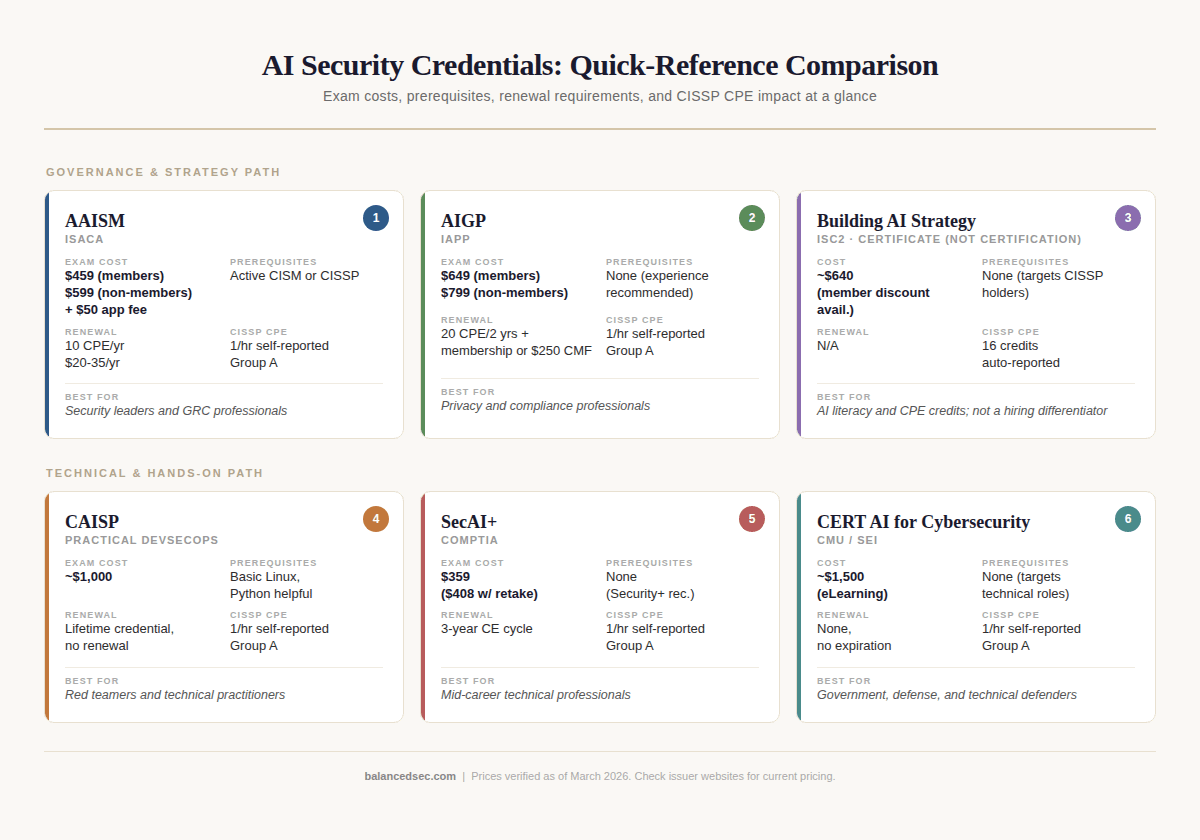
ISACA AAISM is the heavyweight. Requires active CISM or CISSP. Focuses on AI risk identification, policy, and responsible enterprise use. Exam: $459 (members) / $599 (non-members) + $50 application fee. Maintenance: $20-35/year, 10 CPE/year. Best for security leaders and GRC professionals.
IAPP AIGP sits at the intersection of privacy, compliance, and AI governance. Not security-specific. Covers EU AI Act, NIST AI RMF, ISO/IEC 23894. Exam: $649 (members) / $799 (non-members). 20 CPE/2 years. Best for privacy and compliance professionals.
The ISC2 Building AI Strategy Certificate is worth mentioning here, even though it’s a professional development course rather than a certification. Sixteen hours of on-demand content, no proctored exam. But it deposits 16 CPE credits directly into your ISC2 account. Roughly $640 with member discount. Good CPE play, but not a hiring differentiator.
For the technical and hands-on path:
CAISP (Practical DevSecOps) is the hands-on option. Thirty-plus labs, six-hour practical exam, 80% to pass. Covers LLM vulnerabilities, MITRE ATLAS defenses, supply chain attacks, prompt injection, and RAG security. Lifetime credential, no renewal. ~$1,000. Strong training, practical depth, but limited name recognition next to ISC2 or ISACA.
CompTIA SecAI+ launched February 17, 2026. “Securing AI Systems” was weighted at 40% of the exam. Proctored, vendor-neutral, CY0-001. Voucher: $359, or $408 with retake assurance. In my opinion, CompTIA certs don’t command the respect of others on this list, but their market reach could make them appealing to employers.
Also worth a look: SEI/CMU CERT AI for Cybersecurity (~$1,500, no expiration) focuses on applying AI to cybersecurity operations rather than securing AI itself. The CMU/CERT brand carries weight in government and defense.
CPE Credits: The Hidden Upside
Every credential on this list generates CPE credits toward your CISSP renewal (120 credits per three-year cycle, at least 90 Group A). The ISC2 certificate auto-reports 16 credits. For everything else, claim one credit per hour of study, self-reported through the ISC2 CPE portal as Group A. Your AI professional development becomes your CISSP renewal pipeline. Two birds, one investment.
Where Every Credential Falls Short: The Agent Problem
Unfortunately, none of these credentials adequately addresses the security challenges that autonomous AI agents are creating right now.
A Dark Reading poll from early 2026 found that 48% of cybersecurity professionals believe autonomous agents will represent the top attack vector by year’s end. Cisco’s State of AI Security 2026 report found that only 29% of organizations felt prepared to secure their AI deployments despite 83% planning to deploy autonomous capabilities.
OWASP recognized this gap and released a separate Top 10 for Agentic Applications in December 2025. The risks differ from the LLM list: goal hijacking via poisoned documents in retrieval pipelines, tool misuse by agents with legitimate API access, privilege escalation across multi-agent workflows, and cascading failures as a “rapid fan-out” where one decision triggers many downstream tasks.
CAISP comes closest on the technical side, but doesn’t go deep on multi-agent architectures. AAISM addresses governance broadly but not agent-specific operational security. SecAI+ is too new to evaluate here. OWASP’s own free resources, the Agentic Top 10, their Practical Guide to Securing Agentic Applications, and the Agentic AI Threats and Mitigations documents, are currently the most operationally useful guidance available. If your organization runs autonomous agents, these aren’t optional reading regardless of which certification you hold.
The Bottom Line
Your CISSP gives you a stronger head start in continuing your AI security education. Pick one supplementary credential that fills a gap you actually feel in your daily work: governance depth (AAISM, AIGP) or technical specificity (CAISP, SecAI+). Don’t chase everything on the market. And recognize that the cutting edge of this field lives in the open-source community right now, in OWASP, MITRE ATLAS, and the security research being published by practitioners working on real deployments.
The certification gets you through the door. Staying current keeps you in the room.
Quick-Reference Comparison