People fail the CISSP for several common reasons. Examples include choosing the technically perfect answer over the business-aligned one, misreading the adaptive format, and failing to prioritize studying weak domains. Failing the CISSP is more common than the celebratory LinkedIn posts would have you believe. The exam is broad; the Computerized Adaptive Testing (CAT) format can be challenging, and plenty of sharp, experienced practitioners walk out of the testing center disappointed on their first try. If that’s you, you’re in good company. The failure doesn’t define you or your abilities; it points you in the direction you should grow and spend your time.
A retake adds a few new parameters and reframes the focus on your next steps. The first time, you’re building coverage across eight domains. The test format and cadence are new. The second time, you already have a map of the terrain and a new guide to weak areas provided directly from ISC2. The job now is to read that map correctly, understand how the exam actually scores you, and pick a timeline that matches how close you came.
Your new playbook
Before you plan anything, let’s get the boundaries straight. ISC2 enforces mandatory waiting periods between attempts (isc2.org/exams/after-your-exam):
After your first failure, you can retest after 30 test-free days.
If you need a second retake, you have to be 60 test-free days from your most recent attempt.
For a third or subsequent failure, there must be a 90-day test-free gap before trying again.
You can attempt any ISC2 exam up to 4 times in a rolling 12-month period.
Don’t confuse that mandatory cooling-off period with your study runway. They’re two separate clocks. That first 30-day window is only the earliest ISC2 will let you back in the chair. How long you actually take to prepare is your call, and it should depend on how far off you were, not on how fast the rules allow.
One money-saving note. If you bought ISC2’s Peace of Mind Protection before your first attempt, you have a second voucher already, valid for 180 days from purchase with a 30-day gap between sittings (isc2.org/landing/exam-peace-of-mind). If you didn’t buy it up front, you can’t add it retroactively. The exam itself is a meaningful cost (check ISC2’s current pricing page for the exact figure in your region), so factor that into your budget and timeline.
Read your diagnostic report before you touch a book
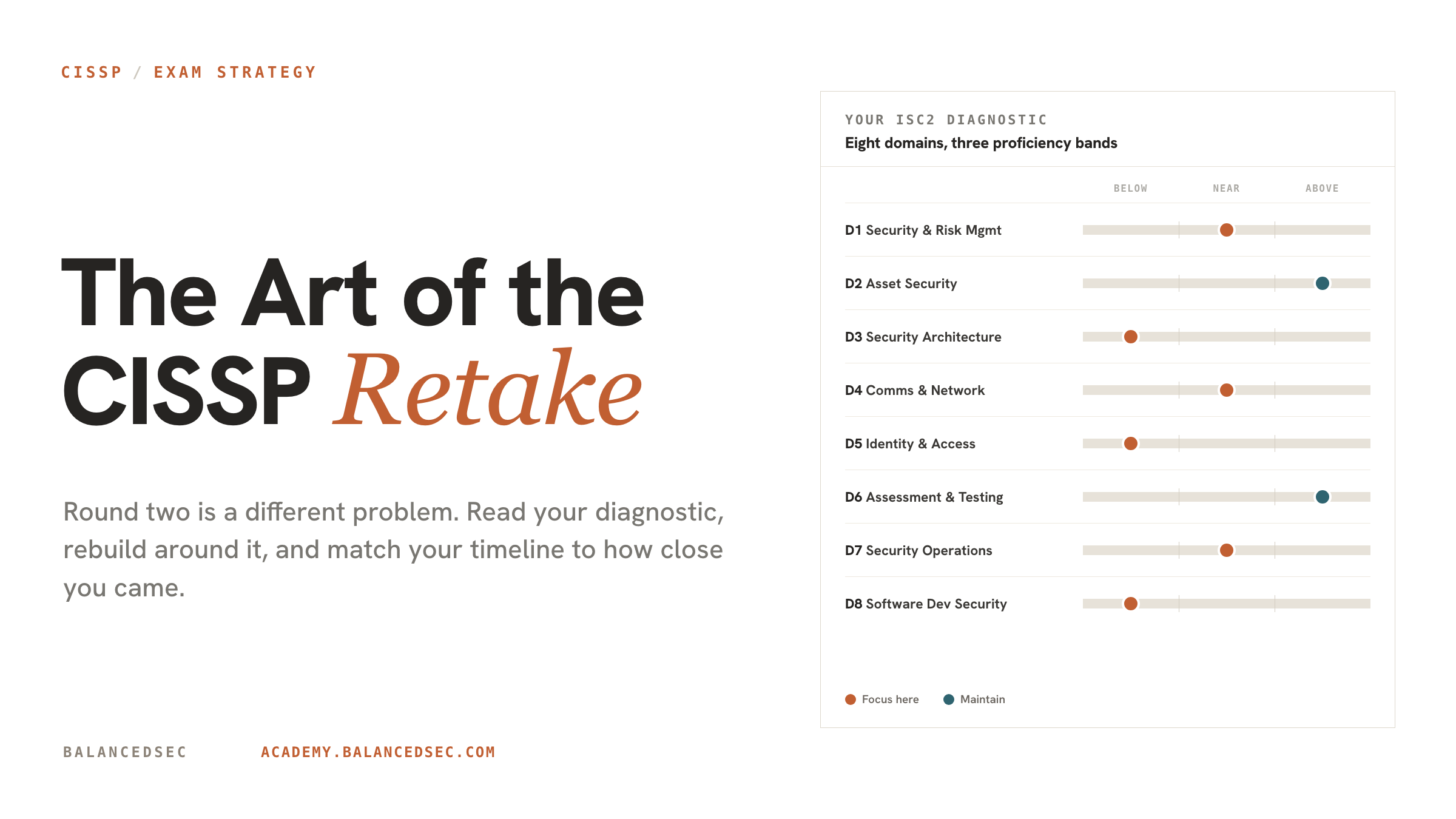
If you fail the exam, ISC2 provides a diagnostic breakdown of the eight domains. There’s no numerical score. Instead, you get three proficiency tiers per domain: Below Proficiency, Near Proficiency, and Above Proficiency, plus a rank ordering of domains by how well you did. That ranking is really useful in planning your strategy for the next attempt.
Work it in this order:
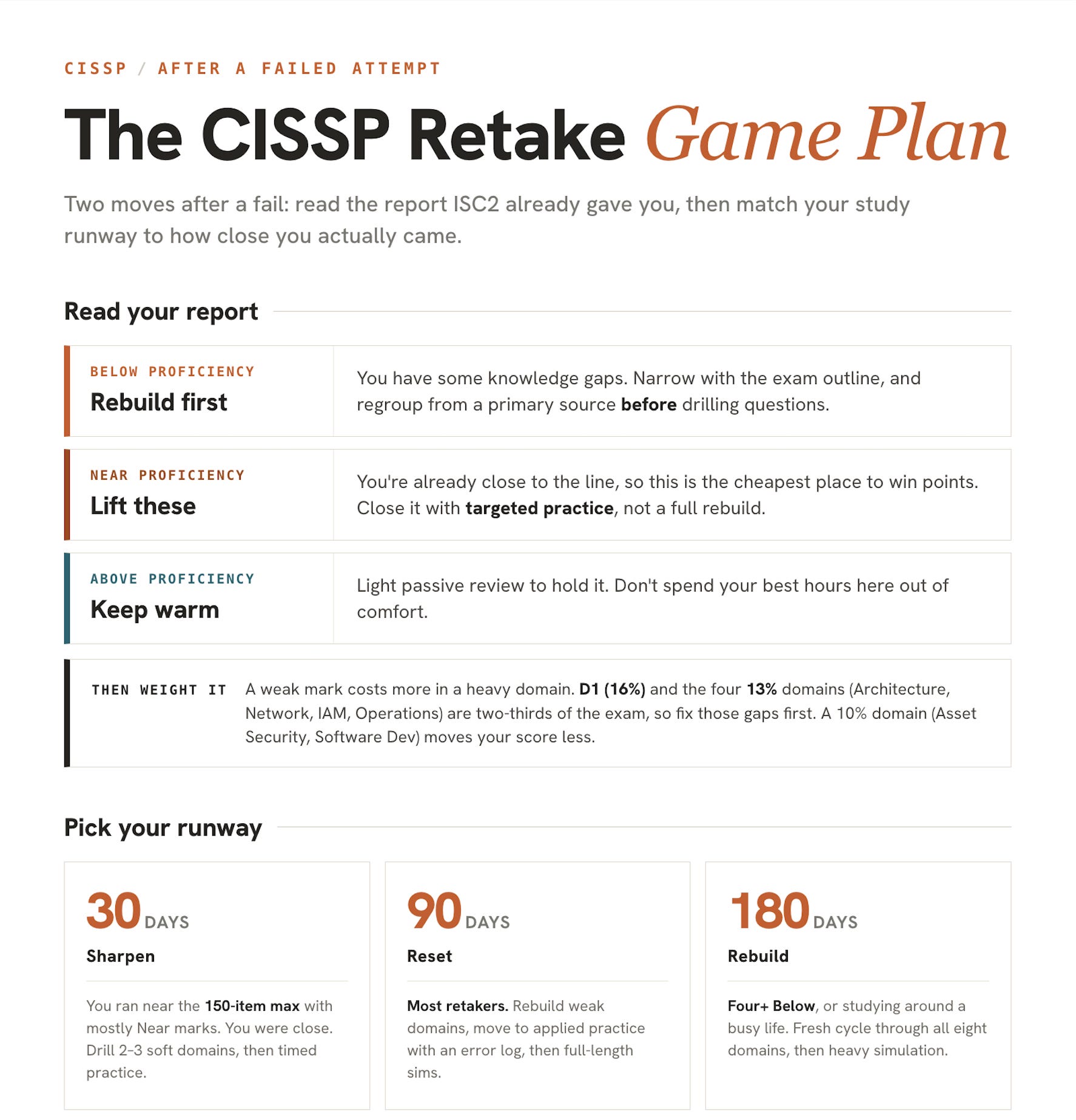
Below Proficiency first. A “below proficiency” mark isn’t a verdict on how hard you worked. The Common Body of Knowledge is enormous, and it’s easy for a domain to get less time than it needed, or for some threads to come loose on exam day. Treat the label as a signal for where focused effort pays off most. Here are some ideas on a few approaches that tend to work better than rereading the domain cover to cover (which may be part of the reason the threads slipped the first time):
Narrow before you dig. Use ISC2’s exam outline as a checklist and rate each objective in the domain: solid, shaky, or new. The “below” score almost always traces to a few specific areas, not the whole domain, which turns a mountain into a short list.
Get the shape first, then the details. Sketch the domain’s structure so that concepts have a frame to hang on to. They stick better on a structure than as a flat list of facts.
Hear it explained a different way. If one pass through the OSG didn’t land, a second identical pass may be doomed to the same fate. A video or a different author on that one topic can frame it in the way that finally clicks.
Explain it out loud. Try teaching the concept in plain language to a study partner or just to the room. Wherever you stall is the precise spot to study next.
Anchor it to something real. Tie the concept to a breach, a control you’ve actually used, or a situation from work. That’s also the shape the exam asks it in, so it does double duty.
Then bring practice questions back in. Once the concept is back in place, questions become the way to test it and to study the reasoning behind every option. Spend as long on why the wrong answers are wrong as on why the right one is right.
Near Proficiency second. A Near mark means you’re already close to the passing line, so these are the cheapest points to win. Close them with targeted practice rather than a full rebuild.
Above Proficiency last. Light passive review to keep it warm. Don’t spend your best hours here out of comfort.
One factor cuts across all three tiers: domain weight. A weak mark costs more in a heavy domain. Domain 1 leads at 16%, and four more tie at 13% each (Security Architecture, Communication and Network, IAM, and Security Operations), together two-thirds of the exam, so a gap there is worth closing first. The same gap in Asset Security or Software Development Security (10% each) moves your overall score less. Spend your best hours where weak meets heavy.
Reading the report is the easy part. The real work is turning that ranking into a sequenced, time-boxed plan you’ll actually follow, and then holding to it.
How the CAT actually scores you (and the myth that wastes retakers’ time)
This is where a lot of retake advice goes wrong, so it’s worth reviewing.
CISSP CAT scoring is compensatory. There is no per-domain pass mark. Your pass or fail comes down to a single overall ability estimate measured against one standard (700 on a 0 to 1000 scale) across all the operational items you answer. Strong performance in one area genuinely offsets weakness in another. ISC2’s scoring FAQ says it directly: its exams are “compensatory,” so “a higher number of items answered correctly in one domain [can] compensate for a lower performance in another domain,” and “a single pass/fail result is calculated on the total of all operational items” (ISC2 exam-scoring FAQ).
Why does Domain 1 keep coming up? Not because the engine “targets” it or because fixing it cascades into your architecture score. It’s simpler: at 16%, Domain 1 is the largest single block of the exam, so it gives you the most compensatory headroom. Nothing more mystical than weight.
The engine picks each question to sit near a 50% chance you’ll get it right, tuned to its current read on your ability. Answer well, and the estimate climbs, and the questions get harder. Miss one and it eases off. So the harder your items feel, the higher the engine currently rates you, which means difficulty isn’t meaningless.
The trouble is you can’t read it reliably from the chair. Every item is aimed at your personal edge, so it feels punishing whether you’re passing or failing. About a quarter of the items aren’t even scored. They’re pretest questions being trialed for future exams, and you can’t tell them from the real ones. And you never see your own estimate. Expect it to feel hard, take that as the format doing its job, and don’t try to grade yourself mid-exam.
Where the exam ends, though, is a signal. It stops early once it’s 95% confident you’re clearly above or clearly below the line (after a 100-item minimum), and runs to its 150-item maximum only when you’re close enough that it can’t reach that confidence. So a fail at the short end means the algorithm got sure quickly, and a fail near 150 items means you were sitting right on the boundary. Both tell you how hard to push next time.
For reference, the current CISSP CAT is 100-150 items over 3 hours, post-April 2024 (see the ISC2.org exam outline).
Pick your timeline from where you landed
Match your study runway to your diagnostic, not to the calendar minimum.
The 30-day sharpen. For candidates who ran near the 150-item ceiling with mostly Near ratings, you were close. Spend the first week on frameworks and mindset, the middle two weeks drilling your two or three softest domains, and the final stretch on timed practice and pacing. Rest before exam day.
The 90-day reset. The right choice for most retakers. Month one, rebuild your weakest domains from primary sources and draw the connections between technical controls and the governance behind them. Month two, shift to applied practice with a running error log (what you missed, why your reasoning failed, what the better answer protects). Month three, full-length timed simulations to build stamina.
The 180-day rebuild. For candidates sitting below in four or more domains, or anyone fitting study around a demanding job (and life). Treat it as a fresh cycle through all eight domains, then layer in study-group discussion and heavy simulation in the back third. Explaining a concept out loud to another candidate is one of the fastest ways to find out whether you actually know it.
The mindset shift that decides most retakes
The most common reason strong technical people fail the CISSP is answering as an engineer when the exam wants a manager or owner perspective. I wrote a full method for working on hard questions in “Strategy Guide for Answering Difficult CISSP Questions”, so I’ll keep it short here. The engineer reaches for the immediate technical fix. The exam usually rewards the governance move: assess the risk, follow the process, align with the incident response plan, and the organization’s risk tolerance.
Treat that as a tiebreaker, not an iron law. Plenty of questions have a correct technical answer. What decides the right path is the qualifier in the question. Watch for MOST, LEAST, FIRST, and BEST, because they can completely change the answer. A useful habit under a wall of technical detail: read the final sentence first. CISSP items often bury a high-level policy question at the end of a paragraph of noise.
One retake-specific warning. If you’re reusing a question bank you’ve seen before, you’re now testing your memory of answers, not your understanding. Force yourself to state the principle behind each answer before you pick it. If you can’t explain why the other three options fail, score it as a miss even if you “knew” it was C.
How my resources fit
Everything above works with any good materials. Here’s how mine fit—one is free for good, and one is free for now.
Always free: the BalancedSec GitHub study notes. They condense the ISC2 Study Guide domain by domain along the exam outline, so they double as a distilled primary text and the checklist for your rebuild. No signup, no cost, and they stay that way. If you use nothing else of mine, consider these.
Free for now: the BalancedSec Academy (founding beta). This is the piece for the hard part: turning your weak domains into a plan you actually work. It runs CAT-style practice that surfaces weak areas, builds a study plan that adapts to them and your exam date, drills the owner/manager mindset through scenario questions, and includes my book, CISSP: A Balanced Approach, in-app (organized around ISC2 exam objectives). It’s in founding beta, so it’s free while that lasts.
A retake isn’t a verdict on whether you belong in this field. It’s a measurement, and this time you aren’t starting from a blank page. You have the report. Read it, respect the timeline, and go take it back.