

The CISSP has a reputation as one of the hardest and most respected security exams, and it earns that reputation. It’s broad, it’s written to catch the overconfident, and it runs on a format built to keep you off balance. Nobody publishes an official pass rate, but enough capable, experienced people fall short on the first attempt that the question is worth taking seriously: why?
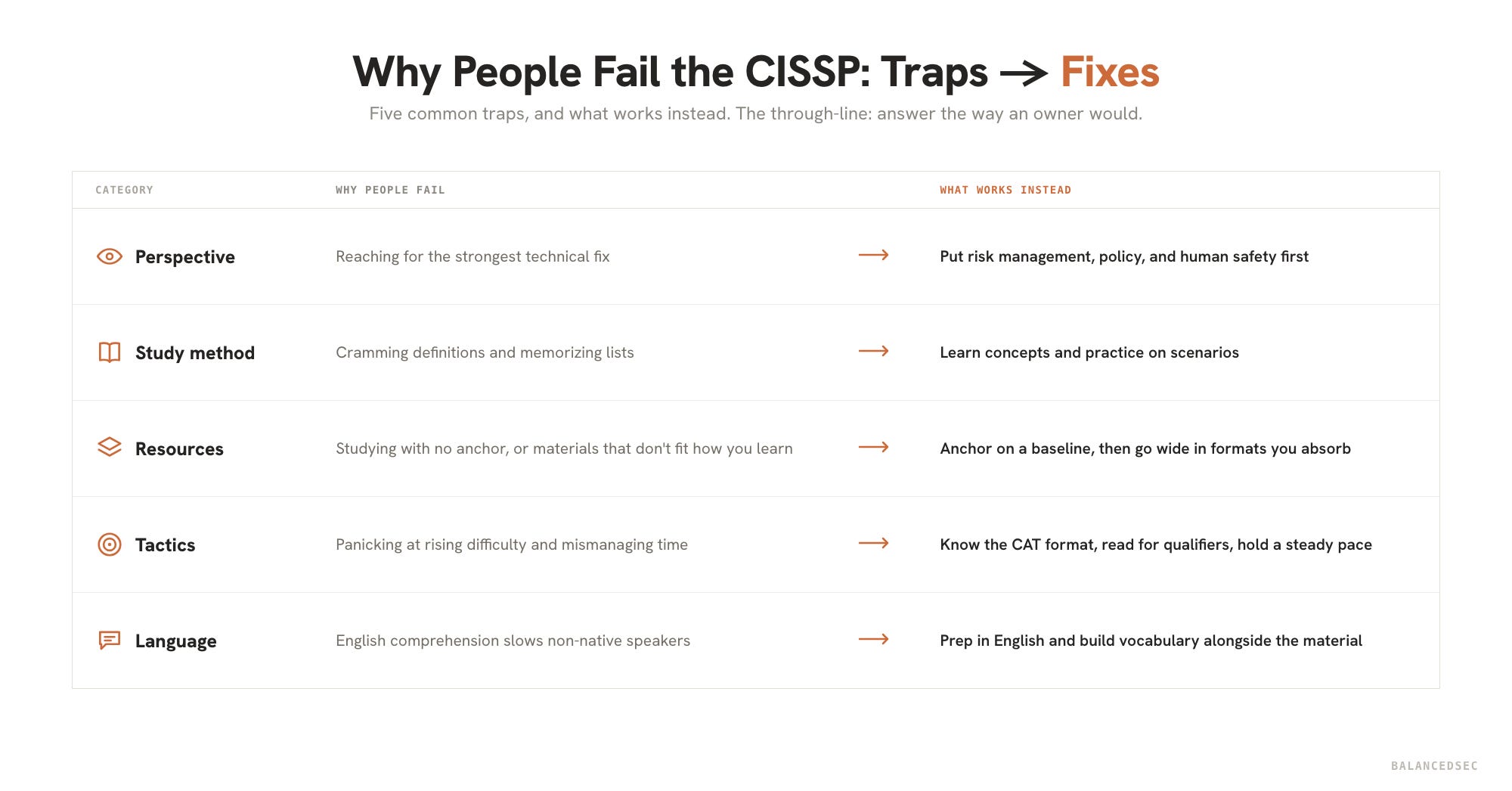
Many people fail for the same short list of reasons, and almost none of them stem from not “knowing enough about security.” They come down to your prep, your in-exam thought process, and how you handle the pressure. That’s a gift because predictable mistakes are avoidable. Knowing the traps before you sit down is one of the biggest advantages you can bring into the exam room. Here are the most common reasons people fail, and how to beat them.
Six traps, and how to beat each one
1. The technical trap
This is the big one, and it can catch even the strongest candidates. Experienced practitioners want to answer questions from, well, their experience. If much of that experience is “hands-on,” it can very well mean applying a technician’s lens to the questions. You really know your stuff, and you’ve been doing it for a hot minute. You see a problem, and your instinct is to reach for the hands-on fix: block the port, patch the service, contain the threat.
But the CISSP isn’t testing that instinct. The exam wants you to view risk, governance, and security from an organizational perspective. The technical fix may disregard the root problem, and we need to treat the organization holistically. We’re striving for a balance between driving security to reduce organizational risk and not standing in the way of goal achievement. And it can be a tricky stance to take. We want to view security programmatically, thinking like a CISO or a senior risk advisor. Answering questions from that higher-level policy, governance, and organizational risk perspective. People fail because they pick the technically perfect option over the one that fits how a business actually makes security decisions. The better you are at the technical job, the more likely this is to trip you up, because your instincts are well-trained for the work and misaligned for the test.
There’s a second version of this trap that’s easy to miss. Years on the job build habits, and some of those habits quietly disagree with the standardized answer the exam wants. If your shop handles something a certain way, that doesn’t make it the CISSP-correct way. Passing means being willing to set aside how it’s done at your desk and answer the way the Common Body of Knowledge defines it. Experience is an asset here, right up until it argues with the exam.
How to beat it: think like the CEO or owner. When you read a scenario, separate the business problem from the technical symptom before you look at the answers. A few habits keep you on the right side of it:
Risk and policy first. Look for the answer that establishes governance, reviews the business case, or runs a risk assessment before deploying a technical control.
Pick the answer that covers the most ground. When several options are technically correct, choose the one that protects the organization’s overall risk posture rather than the narrow fix.
Human life wins, every time. In any physical security, business continuity, or disaster recovery scenario, personnel safety comes before equipment, money, and data.
Be able to explain it. A security manager has to justify decisions to people who don’t live in security. Some questions test whether you can pick the answer a non-technical executive or board would understand and back, not just the one that’s technically sharpest.
Then read the question like a lawyer. A law degree is, of course, not required, but put on your “attorney hat” and read carefully and purposely:
Find the qualifier. Words like MOST, BEST, FIRST, PRIMARY, and NOT change the whole question. They tell you whether it wants your first action (usually an assessment or a policy step) or the ultimate goal (reducing risk). Remember that there are also processes that work best when followed in a particular sequence (I’m looking at you, Incident Response).
Read it twice. Once for the scenario and to catch the qualifier, once to strip away the noise and find the actual problem. Try to read the question without looking at the potential answers.
Eliminate hard. Two of the four options can usually go fast. Cut the answer that jumps to a technical fix when the question asks what to do first, because the first step is almost always to assess, analyze, or get management’s buy-in. Cut absolutes (always, never, eliminate all risk), since security manages risk rather than erasing it. Cut a control that costs more than the asset is worth. And cut the option that treats the symptom instead of the root cause. What’s left is usually a real 50/50, and now you’re choosing between two answers instead of four.
Rehearse this with scenario-based questions until the business-first answer no longer feels unnatural.
2. Cramming and memorizing
Plenty of candidates treat the CISSP like a vocabulary quiz. They memorize definitions, ciphers, port numbers, and checklists, then walk in and find almost none of it being asked directly.
The questions are likely situational. You may not be asked to define a preventive control, but you will likely be handed a messy scenario and asked which control type fits the budget and the value of the asset in front of you. Experience and cross-domain reasoning help you navigate these beyond mere memorization.
How to beat it: study for understanding, not recall.
Learn how concepts connect, not definitions in isolation. If you can explain why a control exists and when you’d choose it, the scenario questions will seem a lot more natural.
Practice on scenarios, not just flashcards. Work questions that hand you a situation and make you choose.
Active learning over silent reading. Teaching a concept to someone else, mind-mapping a domain, or working through it in a study group exposes the gaps that rereading may miss.
Real examples, not just definitions. Read about ways AI is failing and succeeding, real examples of actual breaches, and case studies. It helps tie concepts together.
3. Studying without an anchor
This one is about structure. You can study a lot and still walk in underprepared, because volume is not the same as a plan. Without a spine for your prep, an anchor to measure new material against, and a clear sense of how you learn best, the hours may not yield the retention or substantive coverage you need. It can be difficult to judge whether you’re covering the right material, in enough depth, at the right pace.
Going wide can be a good thing, and if you have the time, do it. Breadth builds perspective, and perspective is what lets you notice when a resource is off-base or out of step with the exam. Breadth becomes a problem only when there’s no baseline to judge it against, because without an anchor, five slightly different explanations turn into noise instead of a fuller picture.
How to beat it: anchor first, then go wide on purpose.
Build a small core, then read around it. Anchor on one trusted primary text (the official ISC2 CISSP Study Guide, or OSG, is the common baseline) and one solid question bank (the Official Practice Tests, or OPT, its companion, with around 1,300 questions). That core is your spine, and everything else supplements it.
Map everything to the exam outline. Use ISC2’s official CISSP exam outline as your checklist for what’s in scope, so you can place each new resource against it and study the test that actually exists.
Go wide for perspective. With an anchor in place, more viewpoints can help, however, the exam is already wide, so judge the best use of your time accordingly. A second guide for the concepts that won’t click, a video series for framing and priority. Being widely read is what gives you the judgment to spot a resource that’s off.
Match the format to how you learn. Some people internalize by reading and writing concepts out. Others are best reinforced with audio or video. Figure out your own modalities and weight your stack toward them, because the best resource is the one that is easy to actually absorb.
Cross-check against the authority, not against each other. When two sources disagree, the exam outline and official materials are the tiebreaker.
4. CAT panic and bad pacing
The English CISSP uses Computerized Adaptive Testing. You get between 100 and 150 questions within a three-hour window, and the difficulty is likely to increase as you answer correctly.
That last part can feel like a trap. As the questions get harder, candidates assume they’re failing, when a hard question can mean the opposite. Panic can make it harder to answer questions you would otherwise be able to reason through, creating a sense of urgency and leading to second-guessing, and ultimately running out of clock.
How to beat it: work with the format, not against it.
Reframe the hard stretch. When the questions get brutal, that’s often a sign you’re doing well. Expect it, and don’t read difficulty as failure.
It’s one-way. The format serves your next question based on your last answer, so you can’t skip or go back. Make a decisive, educated choice on every item and move on.
Hold a pace. Aim for roughly 50 questions an hour, and glance at the clock every 20 to 25 questions. That’s enough to stay on track without feeding the panic.
Expect the unknown. You will hit topics you never studied. That’s normal. Stay calm, fall back on core principles you’ve learned, cut the distractors, and pick the most organizationally sound answer.
5. Leaning on your strong domains
Most of us live in one or two corners of security at work, say cyberthreat response, or identity and access management, and we get comfortable there. Candidates can lean on that real-world experience and neglect the domains they touch less often. The exam covers all eight, so a lopsided prep produces a lopsided score, and the weak domains drag the whole thing down.
There’s a subtler version of this. The domains aren’t islands, and some of the hardest questions live where they overlap, like identity feeding a business continuity plan or cryptography showing up inside a network design.
How to beat it: study all eight, and target the weak ones.
Find your weak domains and pour time there. Use the practice tests from your stack for diagnostics. Treat every miss as a signal about where to study next, then spend your hours on the uncomfortable domains, not the comfortable ones.
Study the seams. Deliberately work the places where the domains overlap, since that’s where the hardest questions live.
Bring every domain to a baseline, even the ones you think you own.
6. The language tax
The CISSP is as much an English reading test as a security test, and that’s a real headwind if English isn’t your first language. The jargon is dense, the vocabulary is heavy, and plenty of questions turn on a subtle distinction between two words. Every item you have to translate in your head costs time and focus you can’t spare. The exam is offered in only a handful of languages (English, Chinese, German, Japanese, Korean, and Spanish), so for most non-native speakers, English is the only option.
How to beat it: prepare for the language, not just the material.
Immerse in English. Do your prep in English rather than translating from your first language, so exam-day reading feels familiar.
Practice on English questions. Get used to how the exam phrases things, including the qualifiers that carry the whole question.
Build vocabulary alongside the content. Keep a running list of the terms and turns of phrase that slow you down.
None of this is a wall. People clear it every year with prep aimed squarely at the language, not just the material.
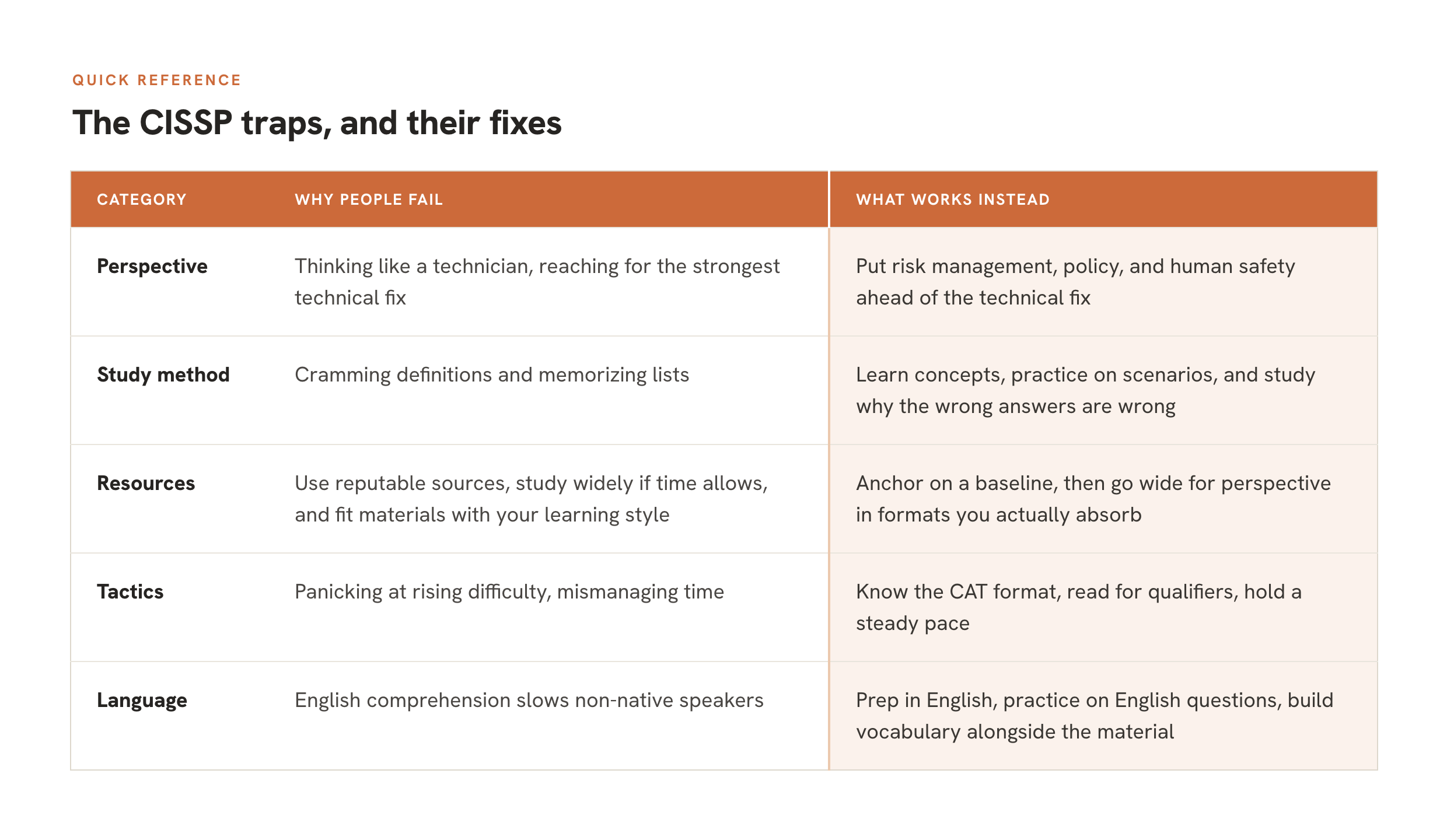
The resources I’ve built
Everything above works with any good materials. Here’s how mine fit -- one is free for good, one is free for now.
Always free: the BalancedSec GitHub study notes. My notes condense the OSG and are organized domain by domain along ISC2’s exam outline, so they double as the spine and a distilled version of the primary text. No signup, no cost, and they stay that way. Readers have told me the notes were the backbone of their prep, and there are testimonials on balancedsec.com if you want to see what people got out of them. If you use nothing else of mine, use these.
Free for now: BalancedSec Academy (founding beta). It runs CAT-style practice exams to surface your weak domains, builds a study plan that adapts to them and your exam date, drills the owner/manager mindset through scenario questions, and includes my book, CISSP: A Balanced Approach, in-app (organized along the same outline). It’s in founding beta right now, so it’s free while that lasts. Use it if it helps, or stick with the free notes.
Passing the CISSP has never been about being the smartest person in the room. It comes down to studying your weak spots, learning to think like the owner/manager the exam is written for, and keeping your composure when it pushes back. All of that is learnable, and you now have a map of exactly what to practice. Trust your preparation, believe you can do this, and the exam becomes a challenge you’re ready for instead of one waiting to surprise you. Knowing where the traps are is your advantage: go use it.