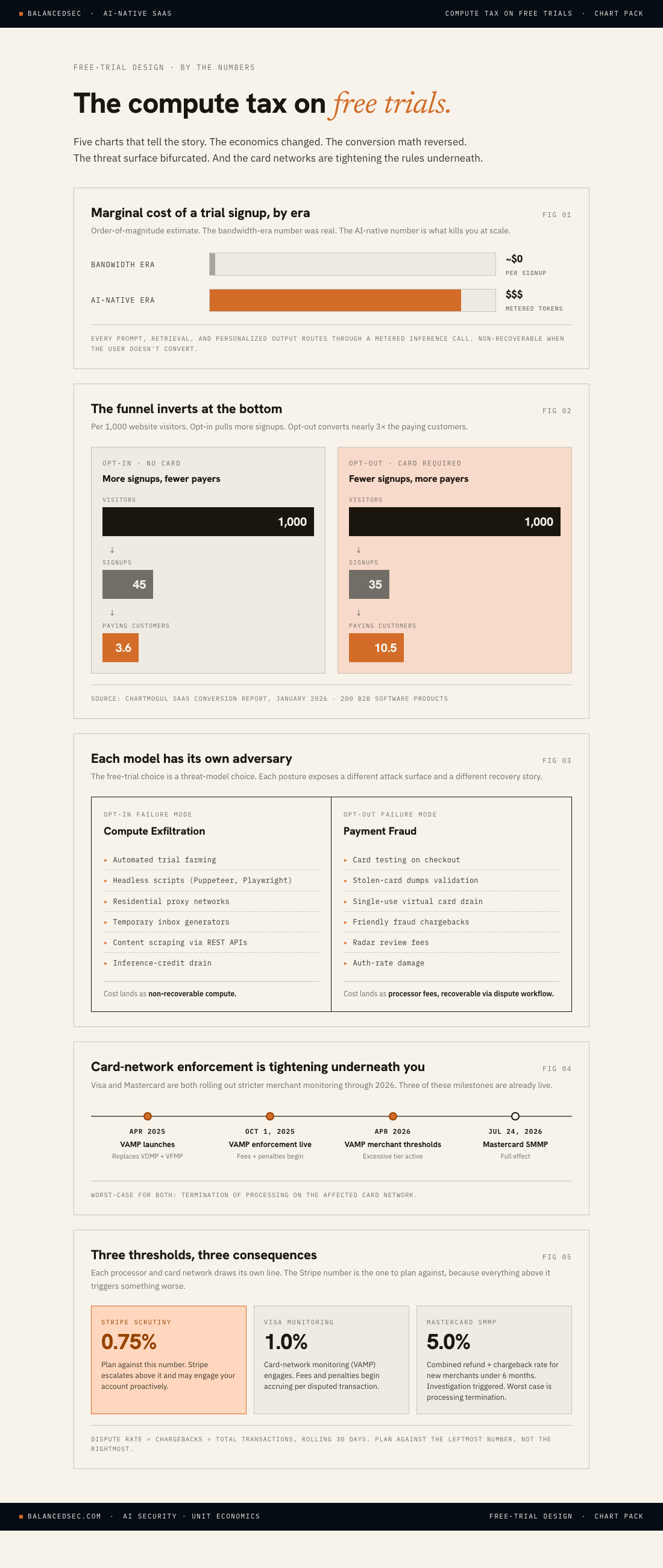
For two decades, the SaaS playbook on free trials was simple: the marginal cost of letting one more person try the product was effectively zero. Bandwidth was cheap, database reads were cheap, and a trial signup that never converted cost the business almost nothing. Generous free trials were basically free to give away.
AI-native platforms have broken that math. Every prompt sent to a frontier model, every retrieval-augmented query, every personalized explanation routes through a metered inference call. The marginal cost per trial signup is no longer near zero. It’s measurable, often material, and almost always non-recoverable when the user doesn’t convert. The economics of free trials need a fresh look.
I’m working through this decision right now for a CISSP exam prep platform I’m building. The product combines a large proprietary practice-question bank, an adaptive CAT engine, an in-app full-text version of my book CISSP: A Balanced Approach, and AI features that lean heavily on premium models: a personalized in-context coach, mindset pattern analysis, and dynamic answer rationales that go beyond what I’ve written. Every one of those AI features costs real money per use. Free-trial design has become a three-way decision: marketing reach, security exposure, and unit economics.
Here is my reasoning through that decision and the security trade-offs each option carries.
Opt-In vs. Opt-Out
The first fork is whether to require a credit card before someone gets to use the product. Opt-in (no card required) is frictionless and historically draws a larger top-of-funnel. Opt-out (requiring a card upfront) reduces sign-up volume but serves as a self-qualification gate. ChartMogul’s January 2026 SaaS Conversion Report, based on 200 B2B software products, puts hard numbers on the trade-off. Per 1,000 website visitors, an opt-in trial typically produces about 45 signups and 3.6 paying customers. An opt-out trial produces about 35 signups and 10.5 paying customers. So opt-in pulls roughly 30% more signups, but opt-out produces nearly 3x the paying customers. Stated as trial-to-paid conversion, no-credit-card trials sit in the 4-6% range, and credit-card-required trials sit around 30%, more than 5x higher.
For a conventional SaaS product, that’s a marketing decision. For an AI-native product, it’s also a threat-model decision because each model targets a different adversary class.
The opt-in failure mode is automated trial farming. With no financial identity at the door, attackers can use headless browser scripts (Puppeteer, Playwright), temporary inbox generators, and residential proxy networks (Bright Data, Oxylabs) to bypass standard IP-based rate limits. Once inside, two attacks run in parallel: (1) walking your REST endpoints to dump proprietary content like a test bank or curated explanations, and (2) hammering the most expensive AI features to drain inference credits for personal use, resale, or training a copycat model. The cost falls on you as non-recoverable compute.
The opt-out failure mode is payment fraud. Putting a card form at the top of the funnel attracts a different adversary: carders running stolen-card dumps against your checkout endpoint to validate live numbers, and abusers feeding single-use virtual cards (privacy.com, Revolut) that pass a $0 authorization and then go dead before the first real charge. The cost includes processor review fees, chargeback exposure, and merchant-account standing.
For my platform, I’m landing on opt-out for three reasons:
The compute exposure on opt-in is asymmetric. A single determined adversary with a residential proxy pool can extract thousands of dollars in inference cost in a weekend. Recovering it is not realistic. Recovering payment-fraud losses, by contrast, is a workflow that processors already run for me.
Self-qualification matters more when seats are expensive to serve. A ~30% conversion rate on a smaller pool of higher-intent users is a better fit for a product where every active trial user is burning real money in tokens.
It lets me push off device fingerprinting. This is the part nobody talks about. If I went opt-in, I’d need a custom abuse stack from day one: device fingerprinting, behavioral signals, residential-ASN detection, link-graph clustering. With opt-out, the identity boundary moves to the financial system, which is the part of the internet where identity already costs something to fake.
How the Posture Slims: Shifting Identity to the Financial Layer
The core idea: in opt-in, you build a “proxy identity” yourself because emails are free and unlimited. In opt-out, you outsource identity to the card network, where supply is constrained, fraud is regulated, and the processors already operate a global tracking layer.
That outsourcing works regardless of which processor you pick. Stripe is what I’m using, but the same architectural pattern applies to Adyen, Braintree, Chargebee, Paddle, or any modern PSP with a managed checkout flow and a fraud product. What you get for free, in rough order of value:
1. Card fingerprinting across the processor’s network. Modern processors see the same card across many merchants. Stripe alone processed $1.9 trillion in transaction volume in 2025, and reports that 90% of the cards used on its network have been seen more than once across different merchants. Adyen and Braintree have comparable cross-merchant signals on a smaller scale. A card with a history of trial-abuse showing up at other merchants will get flagged before it ever creates an account on your platform.
2. Built-in trial-abuse models. Most processors now ship a free-trial-abuse product as a one-click feature rather than a custom build. Stripe Radar’s Free Trial Abuse Prevention, launched in 2025, claims 90% accuracy at flagging signups likely to violate trial terms. In its first two months across four high-growth AI businesses, Stripe blocked over 550,000 high-risk trials and reported $4.4M in prevented downstream compute losses. Other processors offer analogous features under different names. The point is that the processor’s centralized view of card and bank identification number (BIN) behavior is doing work that you’d otherwise have to build in-house.
3. Lightweight pre-checkout gating. A few cheap filters in front of checkout keep the customer database clean and stop low-effort scripts before they reach the payment layer:
Disposable email blocks. Server-side validation against a maintained list of throwaway domains. Free or low-cost APIs (NinjaPear, DeBounce, AbstractAPI) handle this.
Email alias and syntax checks. Block +alias spamming and obvious typos at the form level.
A bot challenge at signup. Cloudflare Turnstile, hCaptcha, or Google reCAPTCHA. Low friction for humans, high friction for scripts.
With this combination, an abuser has to spend real capital on unique, valid credit cards to automate signups. The economics of attacking the platform invert. The custom device-fingerprinting stack you’d need for opt-in becomes unnecessary on day one.
The New Threat Landscape: Payment-Layer Vulnerabilities
The opt-out posture, however, is slimmer, but not threat-free. Three vectors carry over from the broader card payments ecosystem, regardless of which processor you choose. The mitigations are processor-agnostic in concept, and I’ll note how they look in Stripe specifically since that’s what I’m implementing.
1. Card Testing
A public card form is a target for card testing: criminals with stolen-card dumps fire $0.50 to $1.00 validation charges to find live numbers. Modern processors detect and block most of these, but two costs are still yours:
Review fees on the paid fraud tier. Stripe’s Radar for Fraud Teams add-on costs 7¢ per screened transaction (reduced to $.02 if you’re on Stripe’s standard processing pricing). An overnight botnet of 15,000 attempts can saddle a Fraud Teams subscriber with anywhere from $300 to $1,050 in review fees, depending on tier, even though none of the charges went through. Adyen and Braintree’s enterprise risk products follow the same per-transaction pricing model.
Auth-rate damage. A flood of declines hurts your acceptance-rate signal at the network.
Mitigation, in general: rate-limit your payment endpoints at the network layer (Cloudflare, your WAF, or your edge proxy), and put a bot challenge in front of checkout so high-velocity scripts can’t reach the processor’s backend at all. Stripe Checkout also ships its own managed CAPTCHA, which kicks in dynamically when Stripe’s models detect card-testing patterns.
2. Single-Use Virtual Card Drain
The more sophisticated abuser doesn’t use stolen cards. They use legitimate single-use virtual cards from services such as Privacy.com or Revolut.
The loophole. A trial signup runs a $0 authorization, which the virtual card passes. The abuser then closes the card. When the first real charge fires at the end of the trial, it’s declined. The attacker has now extracted the full trial period of premium AI usage for free.
The detection signal. Virtual and prepaid cards have identifiable BIN ranges. Most processors can flag them.
Mitigation, in general: if this pattern shows up in your data, write a rule against prepaid and known-virtual BINs. In Stripe, this is a custom rule in Radar for Fraud Teams. Other processors expose similar BIN targeting via their rule engines. The cost is that some legitimate users (people who genuinely prefer virtual cards for privacy) get blocked, so you can choose whether to enable this on day one, or only once the data shows it’s a real problem.
3. Friendly Fraud and Card-Network Monitoring
The leading cause of opt-out chargebacks is friendly fraud: a real user signs up, forgets to cancel, sees the charge on their statement, and disputes with their bank instead of asking you for a refund. The threshold of concern is the dispute rate.
Industry standard threshold. Above 0.75% dispute rate, you’re under processor scrutiny. Above 1%, you risk being placed in Visa’s monitoring program. Stripe explicitly recommends staying below 0.75% to avoid being escalated.
Card-network programs. Both card networks run monitoring programs that can ultimately terminate your processing relationship if dispute activity stays elevated. Visa’s Acquirer Monitoring Program (VAMP) replaced the older VDMP and VFMP programs, with enforcement live since October 1, 2025. Mastercard’s Scam Merchant Monitoring Program (SMMP) takes full effect on July 24, 2026, with confirmed scam activity resulting in immediate termination of Mastercard and Maestro processing.
Mitigation, in general: make the trial reminder and cancellation flow nearly impossible to misuse against you. An email 3 days before the charge clearly stating the upcoming amount, plus a one-click cancellation in the user dashboard, converts most would-be disputers into either renewals or clean cancellations. In Stripe specifically, the customer.subscription.trial_will_end webhook is the trigger point. Other processors expose equivalent events.
TL;DR
The marginal-cost economics of AI-native platforms make the free-trial decision a security- and unit-economics decision, not just a marketing one. Opt-in trials draw a larger top-of-funnel but expose you to compute exfiltration via automated farming. Opt-out trials draw a smaller, higher-intent funnel and shift your residual risk into the payment layer, where the processor’s global fraud signal does most of the work you’d otherwise build in-house.
For an AI-native product where each active trial user burns real tokens, the opt-out posture plus pre-checkout gating (disposable email blocks, a bot challenge, and a clean cancellation flow) is the architecture I’m going with. You don’t get an enterprise-grade anti-abuse stack out of it, but you get most of the way there for a fraction of the engineering cost, and you keep your focus on the product instead of fighting botnets.